


What Is Distributed Fulfillment? A Simple Guide for Ecommerce Brands

Distributed Fulfillment: A Summary

Distributed fulfillment is a strategy where inventory is stocked in two or more fulfillment locations so orders can ship from the best location for each customer. How distributed fulfillment works: this logistics strategy leverages multiple locations to improve delivery speed and reduce costs for ecommerce businesses and online businesses.

This article is for ecommerce and online business decision makers considering distributed fulfillment strategies. Distributed fulfillment is increasingly important for meeting customer expectations and controlling costs in modern ecommerce.

In 2026, distributed fulfillment has become a standard requirement for online retailers due to increased consumer expectations and costs. This article will take a deep dive into distributed fulfillment strategies and best practices.

Why distributed fulfillment is trending now

Customers have learned to expect fast delivery. At the same time, high shipping costs are harder to absorb when packages travel farther across the country. Brands that only ship from one location often run into a predictable pattern. Customers close to the warehouse get a great experience. Customers farther away get slower delivery and higher shipping costs. To close the gap, brands lean on expedited shipping, which can erode margin.

Distributed fulfillment is popular because it changes the geometry of shipping. It helps brands meet the two day shipping expectation for the end customer. By bringing inventory closer to the end customer, distributed fulfillment reduces transit times and improves satisfaction. Faster deliveries enhance customer satisfaction and loyalty, leading to repeat purchases. Shorter shipping distances often enable 1-2 day delivery, which aligns with modern consumer expectations. When inventory is closer to customers, more orders can ship with cost-effective services while still arriving quickly.

What distributed fulfillment is (plain English)

Distributed fulfillment requires inventory in two or more fulfillment locations, often referred to as multiple fulfillment centers or distribution centers. If you operate from one fulfillment center, that is centralized fulfillment. Many brands move from centralized to distributed in steps:

  • One fulfillment center: all inventory in one place.
  • Two fulfillment centers: inventory split across two locations so more customers are closer.
  • Three or more locations: inventory distributed across various locations or regions, increasing coverage and requiring more planning and inventory discipline.
  • Multiple fulfillment centers: strategically positioned to optimize shipping efficiency, reduce transit times, and serve customers in different geographic regions.

Distributed fulfillment works by leveraging a network of distribution centers to store and ship physical goods closer to customers. By managing inventory across multiple locations, businesses can handle higher order volumes and unexpected demand spikes, increasing capacity and operational efficiency.

The key point is that distributed fulfillment is not just “more warehouses.” It is a deliberate strategy to reduce average shipping distance, improve speed, and create a more consistent delivery promise across regions.

The business case: cost, speed, and customer experience

Distributed fulfillment is often sold as a speed play, but the strongest business case usually includes all three. By leveraging multiple fulfillment centers and optimizing order fulfillment through a distributed network, brands can improve satisfaction by enabling faster, more reliable delivery and a better overall customer experience.

Distributed fulfillment reduces shipping distance, shortens delivery times, lowers transportation costs, and improves sustainability. By cutting delivery distances, brands can also significantly reduce their carbon footprint, making distributed fulfillment a smart choice for both operational efficiency and environmental responsibility.

1) Cost

Shipping is heavily influenced by distance. When packages travel fewer zones on average, you can often reduce cost per order without changing your packaging or product mix. Rates also depend on factors like package weight, dimensions, service level, and carrier surcharges.

2) Speed

When inventory is closer, ground services can deliver faster. Positioning inventory closer to customers through distributed fulfillment enables even quicker delivery, with some retailers using micro-fulfillment centers to achieve delivery windows as short as one hour. For many brands, this can make two-day delivery achievable for more customers without relying on air, depending on carrier coverage, cutoff times, and seasonal conditions.

3) Customer experience

Customers notice consistency. A brand that delivers quickly to both coasts feels reliable. A brand that delivers quickly only to one region feels hit or miss, even if the products are great.

How distributed fulfillment usually starts (from one location to two)

The definition is straightforward: distributed fulfillment means inventory in two or more fulfillment locations. In practice, the first meaningful step is adding a second fulfillment center, then placing the right SKUs in both places.

Expanding distributed fulfillment may involve building new facilities or leveraging new warehouses through third-party logistics providers to increase geographic reach and improve delivery times. Implementing a distributed model often requires integrating a network of fulfillment partners, including your own facilities, 3PLs, and regional distributors, to optimize inventory allocation and supply chain efficiency.

Why most brands start with one location

One fulfillment center is the default because it keeps operations simple. You manage one inventory pool, one receiving flow, and one set of routines. Forecasting and counting are also easier when everything lives in one place.

What changes when you add a second location

A second location changes the customer map. More orders ship from closer to the customer, which can improve delivery speed and reduce average shipping distance. It also helps make delivery promises feel more consistent across regions. Distributing inventory to other locations requires maintaining safety stock at each facility to prevent stockouts and overselling, ensuring you meet regional demand reliably. Decentralizing inventory through distributed fulfillment can also help businesses avoid overspending on fulfillment as they grow by optimizing shipping costs and operational efficiency.

A simple way to think about it is this: you move from shipping nationwide from one origin to shipping from nearer to where demand is.

When adding more locations helps

After the two location milestone, additional locations can expand the footprint where fast ground delivery is realistic and add resilience if one region is disrupted. Distributing inventory across multiple locations also helps mitigate the impact of natural disasters—such as floods, wildfires, hurricanes, earthquakes, or snowstorms—and reduces the risk of delays from disruptions with shipping carriers. The tradeoff is complexity. Each added location increases the work of forecasting, replenishment, and keeping the right inventory in the right place. Labor shortages in 2026 are driving up warehousing costs, making high-capital investments in automation increasingly necessary.

Inventory placement: the part that makes or breaks distributed fulfillment

Distributed fulfillment is not only about geography. It is also about inventory decisions.

When inventory is split across locations, the goal is to avoid two expensive mistakes: stockouts in one region while another region has excess, and partial shipments because products are not co-located.

High level inventory placement comes down to three questions:

  1. Where does demand come from by region?
  2. Which SKUs drive the most orders and the most margin?
  3. Which items should be duplicated in both locations versus kept in one?

A practical starting point is to place your most frequently ordered SKUs in both locations and keep slower movers centralized until you have better data.

Shipping strategy inside a distributed network

The biggest shipping win from distributed fulfillment is not “faster shipping at any cost.” It is “fast shipping with the right service level.”

Distributed fulfillment allows ecommerce brands to tap into an existing network of distribution centers operated by third-party logistics providers (3PLs). Integrating distributed fulfillment with your ecommerce platform is crucial for seamless order routing and inventory management. Using distributed inventory means each time an order is placed, the distribution center closest to that customer will automatically fulfill the order, improving delivery speed and accuracy. Additionally, working with multiple shipping carriers provides flexibility and helps ensure timely delivery, even if disruptions or delays occur.

One practical way to think about this is the difference between paying for speed and designing for speed. When inventory is closer to customers, you can often hit faster delivery targets with ground services more often, instead of defaulting to air or premium options.

When inventory is closer, more orders can ship via ground and still arrive quickly. Expedited shipping becomes a selective tool instead of a default. Shipping spend also becomes more predictable.

If you are building this blog for a decision maker, you can frame it as a simple trade:

  • One location often means speed requires paying for it.
  • Two locations often means speed is enabled by proximity.

Local delivery and shipping: reaching customers where they are

Local delivery and shipping aren't just operational considerations—they're powerful differentiators that separate industry leaders from followers in today's cutthroat ecommerce landscape. Smart online retailers recognize that lightning-fast, rock-solid shipping has evolved from nice-to-have luxury into non-negotiable table stakes for customer loyalty. Distributed fulfillment delivers this competitive edge by strategically positioning inventory across multiple fulfillment hubs, slashing the distance between products and customers while driving down both shipping costs and delivery timeframes.

Leveraging a distributed fulfillment model empowers ecommerce businesses to revolutionize their fulfillment approach, serving customers with precision efficiency across every shipping zone. When inventory lives closer to end customers, more orders automatically qualify for cost-effective ground shipping, making it effortless to offer free shipping or aggressive discounts without destroying profit margins. This customer-first strategy doesn't just elevate the shopping experience—it creates an unbeatable competitive advantage in an oversaturated market.

Intelligent Inventory Management

Intelligent inventory management forms the backbone of game-changing local delivery operations. Through deep analysis of historical order patterns and strategic supplier partnerships, businesses gain the power to make data-driven decisions about optimal inventory placement and smart stock distribution across warehouse networks. This precision-focused approach eliminates supply chain vulnerability, guarantees inventory availability, and prevents costly dead stock from sitting idle in the wrong locations.

Transportation Optimization

Transportation optimization represents another massive cost-saving opportunity. With inventory distributed strategically across fulfillment centers, ecommerce brands unlock significant savings by minimizing average shipping distances and capitalizing on regional carrier advantages. Advanced tools from leading third-party logistics providers—including cutting-edge warehouse management systems and comprehensive freight auditing—streamline fulfillment operations while keeping expenses locked down tight.

Flexible Shipping Options

Flexible shipping options like curbside pickup and in-store collection further amplify the customer experience by delivering unmatched convenience and speed. Whether customers choose local delivery or traditional shipping methods, distributed fulfillment ensures orders get processed with lightning speed and flawless accuracy, meeting the demanding standards established by today's ecommerce powerhouses.

Adopting a distributed fulfillment strategy ultimately empowers online retailers to slash operational costs, accelerate delivery performance, and skyrocket customer satisfaction scores. As the ecommerce battlefield continues evolving, businesses that invest boldly in strategically located warehouse networks and intelligent inventory positioning will dominate the competition, navigate supply chain challenges effortlessly, exceed rising customer expectations, and drive sustainable, profitable growth.

Peak season and resilience

Distributed fulfillment can also reduce operational risk. During peak season, a single location can become a bottleneck. Adopting a distributed model that leverages various locations helps spread volume, reduce the impact of regional disruptions like weather delays, carrier constraints, or local capacity limits, and increases resilience. Storing inventory across various locations not only optimizes shipping times and reduces costs, but also spreads risk and ensures your business can better serve different markets.

This is especially helpful when your order volume is concentrated in a particular season. Forward positioning inventory ahead of peak can reduce last minute shipping upgrades. However, distributed fulfillment increases complexity across order routing, inventory visibility, and performance tracking, requiring robust systems to manage these challenges effectively.

Is distributed fulfillment worth it? A quick decision framework

Distributed fulfillment is not automatically the right next step. Building new fulfillment facilities can be expensive and time-consuming, so it’s important to weigh the decision carefully. There are trade-offs to consider, such as increased operational complexity versus improved shipping speed and cost savings. Additionally, distributed fulfillment can dramatically reduce a brand's carbon footprint by cutting delivery distance. The simplest way to evaluate it is to look for strong signals.

Signs you are ready

  • A meaningful share of your customers are far from your current fulfillment location
  • Shipping costs are rising faster than revenue per order
  • Customers complain about delivery speed in certain regions
  • Peak season causes repeated shipping upgrades or delays

Signs you should wait or start smaller

  • Your catalog is difficult to forecast or has frequent stock issues
  • Your SKU data is messy or inconsistent
  • Your order volume is still too low to support a second location

What to measure

  • Average shipping zone or average shipping distance
  • Delivery time to key regions
  • Shipping cost per order
  • Stockout rate by SKU

One location vs two locations (simple comparison)
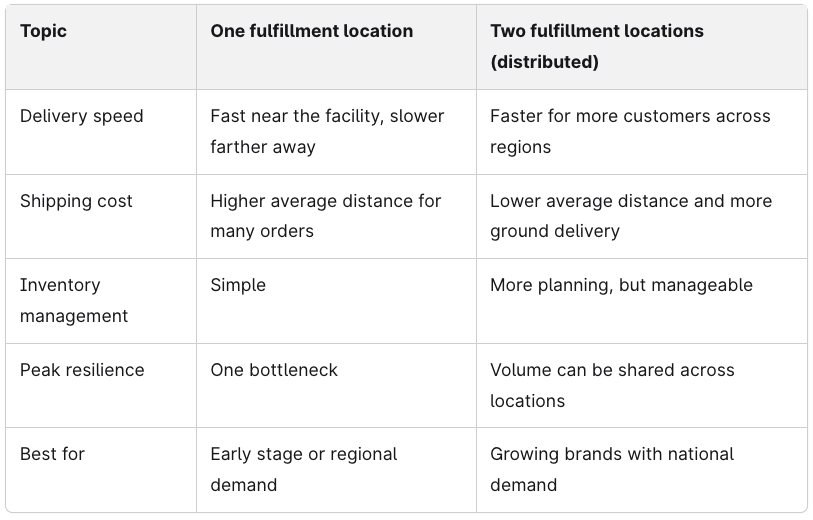
Adopting a distributed model for physical goods offers many advantages, including improved delivery speed, reduced shipping costs, and greater efficiency by keeping inventory closer to customers across multiple fulfillment centers.

How ShipNetwork can help

ShipNetwork provides distributed fulfillment options designed to help brands improve delivery speed while controlling shipping costs. With ShipNetwork, brands gain access to a network of distribution centers and other locations, enabling rapid and efficient expansion without the need for significant capital investment. This strategic use of multiple fulfillment centers across various regions helps mitigate risk, reduce shipping costs and transit times, and improve delivery reliability.

ShipNetwork also supports shipping decisions with KNCT (pronounced “connect”), ShipNetwork’s in-house transportation management system. KNCT helps match each shipment with the best carrier and service level based on speed, cost, and reliability.

ShipNetwork offers three KNCT service levels:

  • KNCT Priority (1 to 3 business days)
  • KNCT Expedited (2 to 5 business days)
  • KNCT Ground (3 to 8 business days)

If you are considering a second location, a good first step is a network review that looks at your customer map, your top SKUs, and the regions where shipping cost and delivery time are hurting the experience.

Request a Quote

Request a Quote: Get a custom fulfillment quote tailored to your business today.

Schedule a Call

Schedule a Call: Talk with a ShipNetwork expert about scaling your logistics.

Learn More

Learn More: Discover how ShipNetwork’s SmartFreight and KNCT solutions can reduce your shipping costs.

FAQs about distributed fulfillment

What is distributed fulfillment?

Distributed fulfillment is a logistics strategy where ecommerce orders are shipped from multiple locations rather than from a single centralized facility.

Is distributed fulfillment the same as having multiple warehouses?

Not exactly. Multiple warehouses are part of it, but distributed fulfillment is a strategy. It includes where inventory is placed and how you design the network to improve speed and cost.

When does a brand become “distributed”?

Most brands become distributed when they add a second fulfillment location and split inventory across both locations.

Does adding a second location always reduce shipping costs?

It often reduces cost by lowering average shipping distance, but results depend on where your customers are and how well inventory is placed across the two locations.

Can two locations help you offer two-day delivery?

For many brands, yes. Being closer to customers can mean more addresses are within a one to two day ground delivery window. Actual transit time varies by carrier, origin ZIP, destination ZIP, and time of year.

What is the biggest risk when adding a second location?

Inventory imbalance. If the wrong SKUs are placed in the wrong region, you can create stockouts, overstocks, or partial shipments.

How do you decide where to put the second location?

Start with your customer map. The best second location usually sits closer to the largest block of demand that is currently far from your first location.

How many locations do most brands need?

Many brands see meaningful benefits at two locations. Additional locations can help, but each one adds complexity. The right number depends on demand, margin, and service expectations.

Is distributed fulfillment only for large brands?

No. It can work for mid market brands too, especially when national demand creates costly long distance shipping from a single location.

How do I know if it is worth it?

Compare the cost and speed impact of adding a second location against the added inventory planning effort. A simple network review is often enough to make an informed decision.

Distributed Fulfillment: A Summary

Distributed fulfillment is a strategy where inventory is stocked in two or more fulfillment locations so orders can ship from the best location for each customer. How distributed fulfillment works: this logistics strategy leverages multiple locations to improve delivery speed and reduce costs for ecommerce businesses and online businesses.

This article is for ecommerce and online business decision makers considering distributed fulfillment strategies. Distributed fulfillment is increasingly important for meeting customer expectations and controlling costs in modern ecommerce.

In 2026, distributed fulfillment has become a standard requirement for online retailers due to increased consumer expectations and costs. This article will take a deep dive into distributed fulfillment strategies and best practices.

Why distributed fulfillment is trending now

Customers have learned to expect fast delivery. At the same time, high shipping costs are harder to absorb when packages travel farther across the country. Brands that only ship from one location often run into a predictable pattern. Customers close to the warehouse get a great experience. Customers farther away get slower delivery and higher shipping costs. To close the gap, brands lean on expedited shipping, which can erode margin.

Distributed fulfillment is popular because it changes the geometry of shipping. It helps brands meet the two day shipping expectation for the end customer. By bringing inventory closer to the end customer, distributed fulfillment reduces transit times and improves satisfaction. Faster deliveries enhance customer satisfaction and loyalty, leading to repeat purchases. Shorter shipping distances often enable 1-2 day delivery, which aligns with modern consumer expectations. When inventory is closer to customers, more orders can ship with cost-effective services while still arriving quickly.

What distributed fulfillment is (plain English)

Distributed fulfillment requires inventory in two or more fulfillment locations, often referred to as multiple fulfillment centers or distribution centers. If you operate from one fulfillment center, that is centralized fulfillment. Many brands move from centralized to distributed in steps:

  • One fulfillment center: all inventory in one place.
  • Two fulfillment centers: inventory split across two locations so more customers are closer.
  • Three or more locations: inventory distributed across various locations or regions, increasing coverage and requiring more planning and inventory discipline.
  • Multiple fulfillment centers: strategically positioned to optimize shipping efficiency, reduce transit times, and serve customers in different geographic regions.

Distributed fulfillment works by leveraging a network of distribution centers to store and ship physical goods closer to customers. By managing inventory across multiple locations, businesses can handle higher order volumes and unexpected demand spikes, increasing capacity and operational efficiency.

The key point is that distributed fulfillment is not just “more warehouses.” It is a deliberate strategy to reduce average shipping distance, improve speed, and create a more consistent delivery promise across regions.

The business case: cost, speed, and customer experience

Distributed fulfillment is often sold as a speed play, but the strongest business case usually includes all three. By leveraging multiple fulfillment centers and optimizing order fulfillment through a distributed network, brands can improve satisfaction by enabling faster, more reliable delivery and a better overall customer experience.

Distributed fulfillment reduces shipping distance, shortens delivery times, lowers transportation costs, and improves sustainability. By cutting delivery distances, brands can also significantly reduce their carbon footprint, making distributed fulfillment a smart choice for both operational efficiency and environmental responsibility.

1) Cost

Shipping is heavily influenced by distance. When packages travel fewer zones on average, you can often reduce cost per order without changing your packaging or product mix. Rates also depend on factors like package weight, dimensions, service level, and carrier surcharges.

2) Speed

When inventory is closer, ground services can deliver faster. Positioning inventory closer to customers through distributed fulfillment enables even quicker delivery, with some retailers using micro-fulfillment centers to achieve delivery windows as short as one hour. For many brands, this can make two-day delivery achievable for more customers without relying on air, depending on carrier coverage, cutoff times, and seasonal conditions.

3) Customer experience

Customers notice consistency. A brand that delivers quickly to both coasts feels reliable. A brand that delivers quickly only to one region feels hit or miss, even if the products are great.

How distributed fulfillment usually starts (from one location to two)

The definition is straightforward: distributed fulfillment means inventory in two or more fulfillment locations. In practice, the first meaningful step is adding a second fulfillment center, then placing the right SKUs in both places.

Expanding distributed fulfillment may involve building new facilities or leveraging new warehouses through third-party logistics providers to increase geographic reach and improve delivery times. Implementing a distributed model often requires integrating a network of fulfillment partners, including your own facilities, 3PLs, and regional distributors, to optimize inventory allocation and supply chain efficiency.

Why most brands start with one location

One fulfillment center is the default because it keeps operations simple. You manage one inventory pool, one receiving flow, and one set of routines. Forecasting and counting are also easier when everything lives in one place.

What changes when you add a second location

A second location changes the customer map. More orders ship from closer to the customer, which can improve delivery speed and reduce average shipping distance. It also helps make delivery promises feel more consistent across regions. Distributing inventory to other locations requires maintaining safety stock at each facility to prevent stockouts and overselling, ensuring you meet regional demand reliably. Decentralizing inventory through distributed fulfillment can also help businesses avoid overspending on fulfillment as they grow by optimizing shipping costs and operational efficiency.

A simple way to think about it is this: you move from shipping nationwide from one origin to shipping from nearer to where demand is.

When adding more locations helps

After the two location milestone, additional locations can expand the footprint where fast ground delivery is realistic and add resilience if one region is disrupted. Distributing inventory across multiple locations also helps mitigate the impact of natural disasters—such as floods, wildfires, hurricanes, earthquakes, or snowstorms—and reduces the risk of delays from disruptions with shipping carriers. The tradeoff is complexity. Each added location increases the work of forecasting, replenishment, and keeping the right inventory in the right place. Labor shortages in 2026 are driving up warehousing costs, making high-capital investments in automation increasingly necessary.

Inventory placement: the part that makes or breaks distributed fulfillment

Distributed fulfillment is not only about geography. It is also about inventory decisions.

When inventory is split across locations, the goal is to avoid two expensive mistakes: stockouts in one region while another region has excess, and partial shipments because products are not co-located.

High level inventory placement comes down to three questions:

  1. Where does demand come from by region?
  2. Which SKUs drive the most orders and the most margin?
  3. Which items should be duplicated in both locations versus kept in one?

A practical starting point is to place your most frequently ordered SKUs in both locations and keep slower movers centralized until you have better data.

Shipping strategy inside a distributed network

The biggest shipping win from distributed fulfillment is not “faster shipping at any cost.” It is “fast shipping with the right service level.”

Distributed fulfillment allows ecommerce brands to tap into an existing network of distribution centers operated by third-party logistics providers (3PLs). Integrating distributed fulfillment with your ecommerce platform is crucial for seamless order routing and inventory management. Using distributed inventory means each time an order is placed, the distribution center closest to that customer will automatically fulfill the order, improving delivery speed and accuracy. Additionally, working with multiple shipping carriers provides flexibility and helps ensure timely delivery, even if disruptions or delays occur.

One practical way to think about this is the difference between paying for speed and designing for speed. When inventory is closer to customers, you can often hit faster delivery targets with ground services more often, instead of defaulting to air or premium options.

When inventory is closer, more orders can ship via ground and still arrive quickly. Expedited shipping becomes a selective tool instead of a default. Shipping spend also becomes more predictable.

If you are building this blog for a decision maker, you can frame it as a simple trade:

  • One location often means speed requires paying for it.
  • Two locations often means speed is enabled by proximity.

Local delivery and shipping: reaching customers where they are

Local delivery and shipping aren't just operational considerations—they're powerful differentiators that separate industry leaders from followers in today's cutthroat ecommerce landscape. Smart online retailers recognize that lightning-fast, rock-solid shipping has evolved from nice-to-have luxury into non-negotiable table stakes for customer loyalty. Distributed fulfillment delivers this competitive edge by strategically positioning inventory across multiple fulfillment hubs, slashing the distance between products and customers while driving down both shipping costs and delivery timeframes.

Leveraging a distributed fulfillment model empowers ecommerce businesses to revolutionize their fulfillment approach, serving customers with precision efficiency across every shipping zone. When inventory lives closer to end customers, more orders automatically qualify for cost-effective ground shipping, making it effortless to offer free shipping or aggressive discounts without destroying profit margins. This customer-first strategy doesn't just elevate the shopping experience—it creates an unbeatable competitive advantage in an oversaturated market.

Intelligent Inventory Management

Intelligent inventory management forms the backbone of game-changing local delivery operations. Through deep analysis of historical order patterns and strategic supplier partnerships, businesses gain the power to make data-driven decisions about optimal inventory placement and smart stock distribution across warehouse networks. This precision-focused approach eliminates supply chain vulnerability, guarantees inventory availability, and prevents costly dead stock from sitting idle in the wrong locations.

Transportation Optimization

Transportation optimization represents another massive cost-saving opportunity. With inventory distributed strategically across fulfillment centers, ecommerce brands unlock significant savings by minimizing average shipping distances and capitalizing on regional carrier advantages. Advanced tools from leading third-party logistics providers—including cutting-edge warehouse management systems and comprehensive freight auditing—streamline fulfillment operations while keeping expenses locked down tight.

Flexible Shipping Options

Flexible shipping options like curbside pickup and in-store collection further amplify the customer experience by delivering unmatched convenience and speed. Whether customers choose local delivery or traditional shipping methods, distributed fulfillment ensures orders get processed with lightning speed and flawless accuracy, meeting the demanding standards established by today's ecommerce powerhouses.

Adopting a distributed fulfillment strategy ultimately empowers online retailers to slash operational costs, accelerate delivery performance, and skyrocket customer satisfaction scores. As the ecommerce battlefield continues evolving, businesses that invest boldly in strategically located warehouse networks and intelligent inventory positioning will dominate the competition, navigate supply chain challenges effortlessly, exceed rising customer expectations, and drive sustainable, profitable growth.

Peak season and resilience

Distributed fulfillment can also reduce operational risk. During peak season, a single location can become a bottleneck. Adopting a distributed model that leverages various locations helps spread volume, reduce the impact of regional disruptions like weather delays, carrier constraints, or local capacity limits, and increases resilience. Storing inventory across various locations not only optimizes shipping times and reduces costs, but also spreads risk and ensures your business can better serve different markets.

This is especially helpful when your order volume is concentrated in a particular season. Forward positioning inventory ahead of peak can reduce last minute shipping upgrades. However, distributed fulfillment increases complexity across order routing, inventory visibility, and performance tracking, requiring robust systems to manage these challenges effectively.

Is distributed fulfillment worth it? A quick decision framework

Distributed fulfillment is not automatically the right next step. Building new fulfillment facilities can be expensive and time-consuming, so it’s important to weigh the decision carefully. There are trade-offs to consider, such as increased operational complexity versus improved shipping speed and cost savings. Additionally, distributed fulfillment can dramatically reduce a brand's carbon footprint by cutting delivery distance. The simplest way to evaluate it is to look for strong signals.

Signs you are ready

  • A meaningful share of your customers are far from your current fulfillment location
  • Shipping costs are rising faster than revenue per order
  • Customers complain about delivery speed in certain regions
  • Peak season causes repeated shipping upgrades or delays

Signs you should wait or start smaller

  • Your catalog is difficult to forecast or has frequent stock issues
  • Your SKU data is messy or inconsistent
  • Your order volume is still too low to support a second location

What to measure

  • Average shipping zone or average shipping distance
  • Delivery time to key regions
  • Shipping cost per order
  • Stockout rate by SKU

One location vs two locations (simple comparison)

Adopting a distributed model for physical goods offers many advantages, including improved delivery speed, reduced shipping costs, and greater efficiency by keeping inventory closer to customers across multiple fulfillment centers.

How ShipNetwork can help

ShipNetwork provides distributed fulfillment options designed to help brands improve delivery speed while controlling shipping costs. With ShipNetwork, brands gain access to a network of distribution centers and other locations, enabling rapid and efficient expansion without the need for significant capital investment. This strategic use of multiple fulfillment centers across various regions helps mitigate risk, reduce shipping costs and transit times, and improve delivery reliability.

ShipNetwork also supports shipping decisions with KNCT (pronounced “connect”), ShipNetwork’s in-house transportation management system. KNCT helps match each shipment with the best carrier and service level based on speed, cost, and reliability.

ShipNetwork offers three KNCT service levels:

  • KNCT Priority (1 to 3 business days)
  • KNCT Expedited (2 to 5 business days)
  • KNCT Ground (3 to 8 business days)

If you are considering a second location, a good first step is a network review that looks at your customer map, your top SKUs, and the regions where shipping cost and delivery time are hurting the experience.

Request a Quote

Request a Quote: Get a custom fulfillment quote tailored to your business today.

Schedule a Call

Schedule a Call: Talk with a ShipNetwork expert about scaling your logistics.

Learn More

Learn More: Discover how ShipNetwork’s SmartFreight and KNCT solutions can reduce your shipping costs.

FAQs about distributed fulfillment

What is distributed fulfillment?

Distributed fulfillment is a logistics strategy where ecommerce orders are shipped from multiple locations rather than from a single centralized facility.

Is distributed fulfillment the same as having multiple warehouses?

Not exactly. Multiple warehouses are part of it, but distributed fulfillment is a strategy. It includes where inventory is placed and how you design the network to improve speed and cost.

When does a brand become “distributed”?

Most brands become distributed when they add a second fulfillment location and split inventory across both locations.

Does adding a second location always reduce shipping costs?

It often reduces cost by lowering average shipping distance, but results depend on where your customers are and how well inventory is placed across the two locations.

Can two locations help you offer two-day delivery?

For many brands, yes. Being closer to customers can mean more addresses are within a one to two day ground delivery window. Actual transit time varies by carrier, origin ZIP, destination ZIP, and time of year.

What is the biggest risk when adding a second location?

Inventory imbalance. If the wrong SKUs are placed in the wrong region, you can create stockouts, overstocks, or partial shipments.

How do you decide where to put the second location?

Start with your customer map. The best second location usually sits closer to the largest block of demand that is currently far from your first location.

How many locations do most brands need?

Many brands see meaningful benefits at two locations. Additional locations can help, but each one adds complexity. The right number depends on demand, margin, and service expectations.

Is distributed fulfillment only for large brands?

No. It can work for mid market brands too, especially when national demand creates costly long distance shipping from a single location.

How do I know if it is worth it?

Compare the cost and speed impact of adding a second location against the added inventory planning effort. A simple network review is often enough to make an informed decision.

GET STARTED TODAY

Request a Quote

Your eCommerce business has big potential– we know how to fulfill it. Talk to our team today.

  • 77% of U.S. respondents stated that they would absolutely give repeat business to a retailer who resends lost or damaged items with fast shipping.

  • We guarantee to fulfill orders 100% accurately within 1 business day, every time. We always keep it flawless so your growth is endless.

OUR TRUSTED PARTNERS