ShipNetwork vs In-House Fulfillment:

Which Is Better for eCommerce Brands?

ECOMMERCE COMPANIES THAT TRUST US
Scalable
Distribution Network
Designed & Proven at scale.
Custom
Enterprise Integrations
EDI-enabled. Retail-compliant.
Responsive
‍Support Team
Real people. No ticket blackholes.
Who are we

Build with More Speed, Accuracy, and Scalability

In-house fulfillment gives you direct control over your warehouse operations, staff, and fulfillment process. But it also means absorbing every cost and complexity that comes with running that operation yourself. ShipNetwork takes on that operational burden through a 12-facility nationwide network, volume-negotiated carrier rates, SLA-backed accuracy guarantees, and a dedicated US-based account manager.

98%
of US in1–2 days
99.98%
Order accuracy
97%
Client retention
10
Fulfillment centers
The single biggest difference
One model requires you to build and scale fulfillment infrastructure yourself, the other converts that fixed investment into a variable, performance-guaranteed service
What makes us different

ShipNetwork vs In-House Fulfillment: How They Compare at a Glance

Factor ShipNetwork In-House Fulfillment
Upfront investment None, operational cost model Warehouse lease, equipment, staffing, software
Geographic reach 10 facilities, 98% of U.S. in 1–2 days ground Limited to your facility locations
Carrier rates Volume-negotiated rates across network Individual brand rate negotiation
Scalability Scales with order volume, no added overhead Requires hiring, space, and process changes to scale
Staffing and management Handled by ShipNetwork Hiring, training, scheduling, turnover management
Account support Dedicated U.S.-based account manager Internal ops team
Order accuracy 99.99% order accuracy with a 100% order accuracy guarantee Dependent on internal team and process maturity
Multi-channel support DTC, Amazon, wholesale, retail compliance Dependent on internal capability
Experience 2001, 25+ years of operations Limited to internal experience
The headline takeaway: ShipNetwork converts the fixed costs and operational complexity of fulfillment into a performance-guaranteed variable cost model, while in-house fulfillment keeps everything under your roof but requires you to build, staff, and scale it yourself.
Built for High-VolumE

Best For: When to Choose Each Option

Fastest setup
Choose in-house fulfillment if:

Your products require highly specific handling unique to your business - temperature controls, hazardous materials, or extremely customized assembly that no external partner can replicate.

Your order volume is heavily concentrated in one geographic region, making a single facility sufficient. In-house fulfillment provides complete control over inventory and quality in that scenario.

You have the capital, team, and operational bandwidth to build and maintain a proper fulfillment infrastructure without it diverting resources from growth. In-house fulfillment is generally more efficient for businesses with low order volumes where the fixed cost structure is manageable.

Most flexible
Choose ShipNetwork if:

You're spending founder or ops team time on logistics instead of growth. Outsourcing fulfillment allows teams to focus on marketing and product development - the core business activities that drive revenue.

Your shipping costs are rising as a percentage of revenue, and you lack the volume to negotiate competitive carrier rates on your own. 3PLs can reduce shipping costs by 10–50% compared to retail rates.

You're scaling and need fulfillment capacity that can flex with order volume without new hires or leases. Third-party logistics can absorb massive spikes in volume using their labor force and network.

clear indicators to switch

Five Signals It's Time to Switch from In-House:

Shipping costs are rising as a percentage of revenue. No More Fulfillment Headaches

If your shipping rates are climbing and you lack the volume to negotiate competitive discounts, rising fulfillment costs can signal the need for outsourcing. A fulfillment partner with volume-based carrier discounts can immediately compress that line item.

You're hiring to keep pace with orders, not to grow the business.

When every new hire goes to the warehouse floor instead of marketing, product, or sales, your growth trajectory stalls. In-house fulfillment is hard to scale quickly during sudden surges in demand. If staffing is about survival rather than strategy, it's time to evaluate outsourcing to a 3PL.

Ops or founder time is going to logistics instead of product or marketing.

In-house fulfillment requires significant daily operational management. When the people who should be driving customer acquisition and brand strategy are troubleshooting pick-pack workflows, the operational burden has become a competitive disadvantage. Outsourcing allows businesses to focus on core activities.

You can't reach customers fast enough as you expand geographically.

If your single facility means 5–7 day ground shipping to large portions of the country, you're losing customers. 41% of customers won't return after late deliveries. Fulfillment centers strategically placed across a distributed network can achieve 2-day shipping to 90% of the US - coverage that would require massive capital to replicate in-house.

A major retail or wholesale account requires compliance workflows you don't have.

When retailers require EDI, ASNs, routing guides, specific labeling, and case pack configurations, building those capabilities internally is expensive and time-consuming. Storage space limitations and compliance gaps indicate it's time to consider a 3PL with those workflows already built.

3 of 5 Signals Selected?

grow without a worry

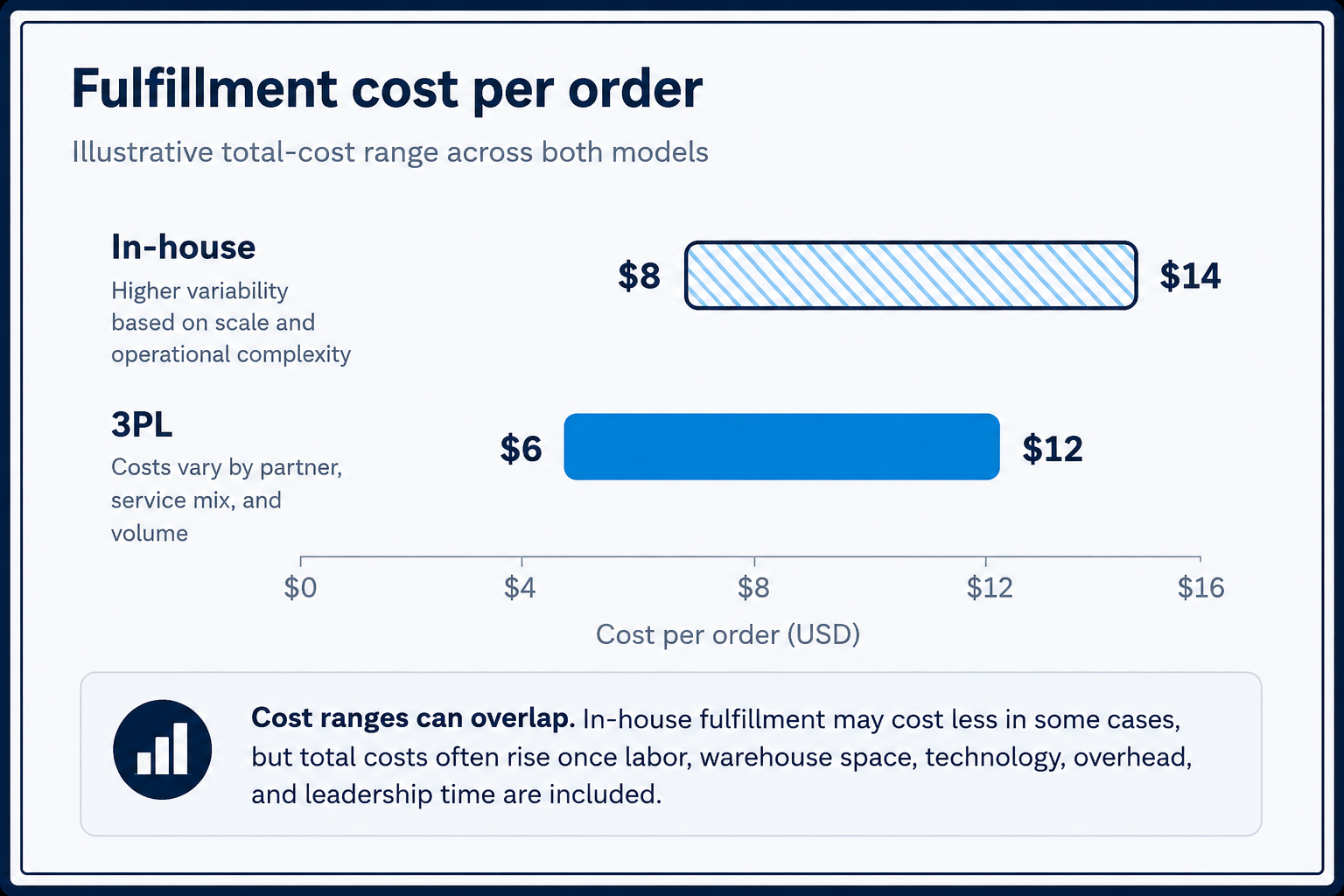
The True Cost of In-House Fulfillment

~$10.18/sq. ft.
Average U.S. industrial asking rents
Warehouse Space and Lease:
The national benchmark for US warehouse lease rates is approximately $10 per square foot in 2026, climbing substantially higher in some coastal and high-demand markets. Industrial leases often require multiyear commitments adding taxes, insurance, and maintenance. Plus, you need enough space to store inventory through peak season, which means paying for capacity you may not use year-round.
~$19–20/hr average wage
Before benefits, overtime, and employer costs
Labor costs:
U.S. warehouse-related roles average roughly $19–20 per hour before payroll taxes, benefits, overtime, training, and seasonal staffing (according to the U.S. Bureau of Labor Statistics). In-house fulfillment also puts hiring, scheduling, and peak labor planning directly on your team.
Capex + upkeep
Racking, forklifts, docks, scanners
Equipment and infrastructure:
Racking, forklifts, packaging stations, shipping docks, barcode scanning hardware, etc. all require upfront capital and ongoing maintenance.
$100s to $1,000s+/mo
Plus implementation and integration costs
Technology:
In-house fulfillment may require shipping, inventory, order management, and warehouse software. Costs rise with order volume, users, locations, integrations, and more advanced workflows, with implementation and hardware adding to the total.
Limited bulk discounts
Smaller brands may pay more per package
Packaging materials:
Purchasing power depends on your own packaging volume and supplier terms. Without bulk discounts, smaller brands pay significantly more per package for boxes, mailers, void fill, and custom packaging inserts.
Carrier pricing adds complexity
Rates negotiated brand-by-brand
Carrier rate negotiation:
In-house fulfillment means managing carrier relationships and rate negotiations directly. Individual brands often have much less negotiating leverage than networks that aggregate substantial shipping volume.
Ongoing overhead
Some costs remain even when volume slows
Management overhead:
Running fulfillment in-house also means carrying the people and operating costs behind the warehouse, including supervisors, operations leadership, HR, safety and compliance, insurance, and utilities. Many of these costs do not rise or fall directly with each order, which can make slower periods less efficient.
Time pulled from growth
Leadership time has a real cost
Hidden and opportunity costs:
In-house fulfillment can pull founders and operations leaders into staffing, warehouse issues, inventory problems, carrier management, and exceptions. That time may not appear in per-order cost calculations, but it still competes with product, customer, and growth priorities.
What You Hand Off. What You Keep Control Of.

ShipNetwork vs In-House Fulfillment: What Changes When You Outsource Fulfillment

What Transfers to ShipNetwork What Stays With You
Warehouse operations, including receiving, inventory management, pick and pack, and outbound shipping Brand voice, packaging design, and unboxing experience. ShipNetwork executes to your specifications for custom packaging and branded inserts.
Staffing and labor management, including hiring, training, scheduling, turnover, and peak season scaling Customer experience standards. You define the SLAs, communications, and service expectations.
Carrier negotiation and shipping optimization, leveraging volume across the entire network Data ownership. Order data, customer data, and SKU-level inventory data remain yours, with full inventory visibility through the client dashboard.
Compliance workflows, including EDI, routing guides, retail and wholesale labeling, and ASN documents Strategic decisions. Product, marketing, pricing, and growth plans stay entirely in your hands.
Returns management, including inspection, restocking, and reverse logistics Return policy and customer experience. You decide the rules, refund approach, and customer-facing experience; we handle the operational workflow behind it.
Equipment, facility maintenance, and fulfillment infrastructure Capital allocation and growth priorities. Your team decides where to invest time and budget without having to own warehouse equipment and facility upkeep.
Outsourcing fulfillment should not mean losing control. ShipNetwork takes on the operational burden while your team keeps control of the brand, customer experience, data, and strategic decisions.
dont over estimate the transition

The Transition: What Switching Actually Looks Like

Step One:
Onboarding
A dedicated account manager owns inventory transfer logistics, system integration, & packaging specification review.
Step Two:
Parallel Operations
Many brands run both systems in parallel during the transition to ensure no orders fall through the cracks.
Step Three:
Test Orders
Test orders validate accuracy, packaging, and delivery timelines before full volume goes live.
Step Four:
Full Volume Live
Click-to-ship time averages 12 hours or less once operational.
TRUSTED BY HIGH-GROWTH BRANDS

Brands That Have Scaled with ShipNetwork

Pooja, COO
"Our partner since 2022. They customized our fulfillment processes as we scaled DTC and wholesale, handled EDI, retail compliance, and adapted with us every step of the way."
Jen, CEO
"Amazing transition with ShipNetwork! The onboarding was smooth and straight forward. The customer service is great, so fast to respond and help us solve our challenges."
Erin, Operations Manager
"The team has been very responsive and flexible. Orders ship fast, even during peaks and flash sales. Customers love the fast delivery."
Jay, CEO
"ShipNetwork gives us peace of mind that packages get to customers on time. They handle supply chain challenges gracefully and help us scale our business."
Tavis Malcolm, Founder
"ShipNetwork helped us with our fulfillment. Even as a small client, we always felt supported. No other partner promoted Morrison Outdoors the way ShipNetwork does."
Brad, Operations Director
"[ShipNetwork] consistently exceeds expectations by accommodating time-sensitive requests, showcasing unparalleled commitment to our customers and the overall success of our organization."
Elizabeth, Founder
"We grew our website sales 10x after switching from in-house fulfillment to ShipNetwork fulfillment services. Partnering with them feels like a true extension of our team."