Introduction/Summary
Subscription box fulfillment operates on a fundamentally different rhythm than standard ecommerce. Instead of reacting to unpredictable one-off orders, you're managing recurring shipments on fixed deadlines - every month, every quarter, without exception. Miss a ship window, and subscriber trust erodes fast. Research shows that 28% of subscription box customers cancel due to poor experience, and fulfillment mistakes can lead directly to customer churn.
Efficient inventory management prevents stockouts in subscription fulfillment, helps monitor product availability for subscriptions, and is critical for maintaining customer satisfaction. That's the paradox of scaling a subscription box business: the very predictability that makes the subscription model attractive also creates rigid operational demands. As your subscriber count grows, so does the complexity of managing changing products, multiple variants, customer preferences, and hard delivery deadlines. Subscription box fulfillment ensures regular delivery of orders, but doing it well at scale requires deliberate strategy.
This guide breaks down six operational strategies that prevent fulfillment bottlenecks, protect customer retention, and keep your subscription fulfillment process running cleanly as volumes increase.
How We Evaluated These Scaling Strategies
Each strategy was evaluated across seven criteria that matter most when scaling recurring orders:
- Scalability potential during rapid growth phases
- Impact on order accuracy and consistency across cycles
- Cost efficiency as volumes increase from hundreds to thousands of boxes
- Technology integration capabilities with subscription platforms and warehouse management system tools
- Flexibility to handle subscription model variations (tiers, add-ons, skips)
- Customer experience enhancement through timely and accurate deliveries
- Operational complexity reduction - eliminating chaos, not adding to it
Top 6 Operational Strategies for Scaling Subscription Box Fulfillment
1. Advanced Kitting and Assembly Operations
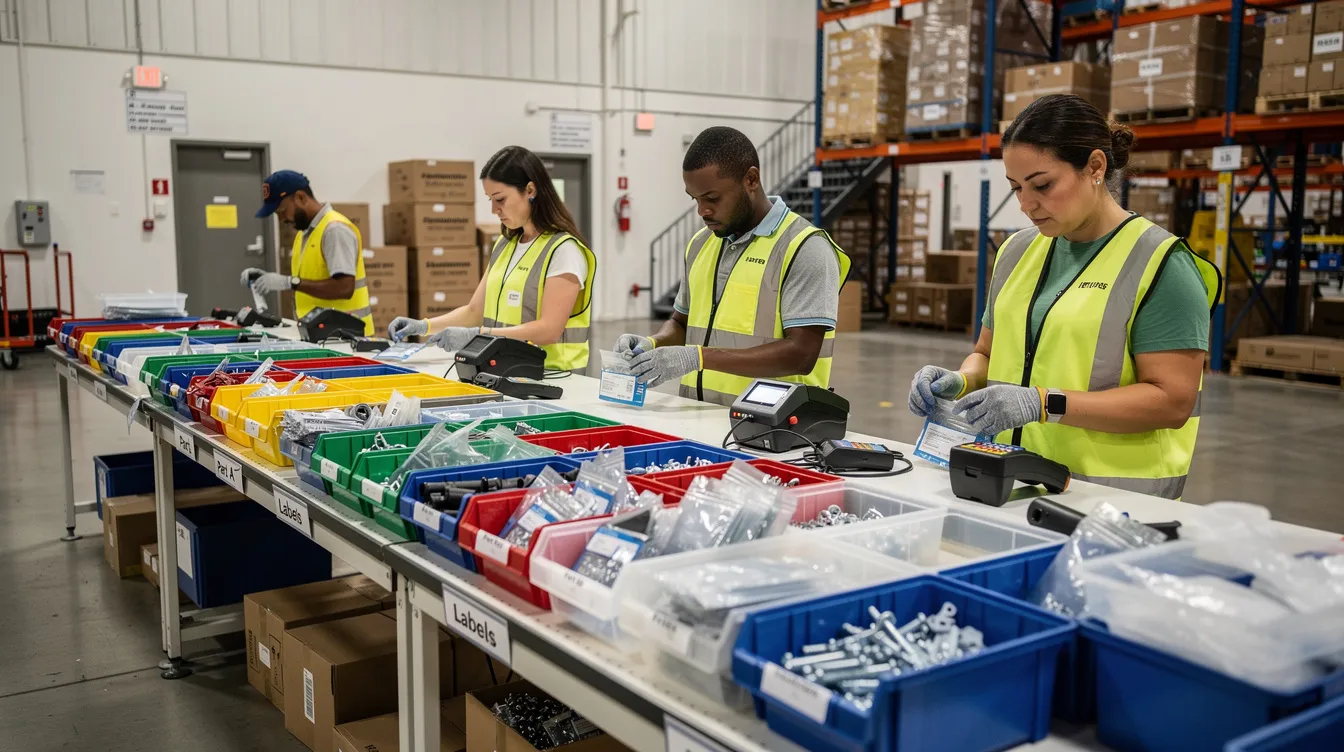
Kitting is the process of assembling multiple component SKUs into a single finished SKU - your monthly subscription box. The 3PL or in-house team receives all individual products, inserts, and packaging materials, then combines them according to a Bill of Materials (BOM) before the ship window opens.
Why It Stands Out
Proper kitting transforms multi-SKU chaos into streamlined single-SKU outbound operations. Instead of picking six or eight individual items per order during your ship window, workers pick one pre-built kit. The heavy lifting - staging, assembly, quality control - happens days or weeks before shipping begins. Kitting and bundling enhance presentation and sales potential for subscription boxes while dramatically reducing per-box error rates.
Best For
Curated subscription boxes with multiple changing products per shipment.
Key Strengths
- Reduces pick-and-pack errors during high-volume periods - professional operations target less than 0.5% assembly error rates
- Enables batch processing for consistent shipping windows (batch processing aids efficiency in small-scale fulfillment operations and scales upward)
- Simplifies inventory tracking through bundle SKU management
Possible Limitations
- Requires upfront assembly labor investment - kitting labor typically adds $0.50–$2.00 per box depending on complexity
- May increase storage requirements before shipping cycles, as finished kits need staging space
2. Predictive Inventory Management Systems
Changing products monthly complicates inventory management significantly. Subscription fulfillment requires tracking two inventory layers simultaneously: component SKUs (individual products, inserts, packaging) and finished kit SKUs (assembled boxes). Minor forecasting errors can disrupt subscription box operations across an entire cycle.
Why It Stands Out
Subscriptions offer something standard ecommerce doesn't: predictable demand. You know roughly how many subscribers you have, your churn rate, skip patterns, and tier distributions. This predictability advantage enables precise inventory management that prevents stockouts and delays - if you build the right forecasting systems around it.
Efficient inventory management prevents stockouts in subscription fulfillment, helps monitor product availability for subscriptions, and is critical for maintaining customer satisfaction.
Best For
Businesses with stable subscriber counts and predictable consumption patterns.
Key Strengths
- Manages component SKU tracking versus bundle SKU complexity through proactive inventory management
- Accounts for subscriber churn mid-cycle inventory implications (e.g., assuming 5% churn on a 10,000-subscriber base means ordering for ~9,500 boxes plus buffer)
- Optimizes storage costs through accurate demand forecasting - efficient inventory management prevents stockouts in subscription fulfillment
Possible Limitations
- Requires sophisticated software integration; automated inventory management improves fulfillment efficiency but demands upfront setup
- Less effective for highly variable subscription products where content shifts dramatically each cycle
Real-time inventory tracking reduces operational costs and errors. Inventory management helps monitor product availability for subscriptions, and meticulous inventory management is critical for maintaining customer satisfaction across every cycle.
3. Subscription-Optimized Packaging Strategy
Subscription boxes aren't just containers - they're brand touchpoints. Custom packaging enhances the unboxing experience for subscribers, turning a delivery into a moment worth sharing. But packaging decisions have direct operational and cost implications that compound at scale.
Why It Stands Out
This strategy balances branded unboxing experience with operational efficiency at scale. The data supports the investment: 34% of customers say branded packaging affects their perception of a brand, and 40% of online shoppers recommend products in branded packaging.
Best For
Subscription brands prioritizing customer retention through memorable unboxing experiences and selling subscriptions where presentation drives loyalty.
Key Strengths
- Custom dimensions reduce shipping costs while maintaining brand impact - dimensional weight optimization can significantly lower shipping costs
- Standardized packaging processes improve assembly speed during build windows
- Branded elements enhance customer lifetime value; personalized packing slips can improve customer satisfaction alongside branded boxes
Possible Limitations
- Higher per-unit packaging costs compared to standard shipping boxes - custom packaging has longer lead times and higher minimum order quantities
- Longer setup times for complex packaging requirements across multiple tiers or seasonal editions
Quality control in packaging reduces errors and increases customer loyalty. Inconsistent interior placement - tissue paper askew, products shifting - creates perceived low quality that undermines even great products.

4. Multi-Warehouse Distribution Network
A single fulfillment center creates a ceiling on delivery speed and a floor on shipping costs. As your subscriber base spreads nationally, zone-based carrier charges eat into margins and extend transit times.
Why It Stands Out
Distributed fulfillment leverages subscription volume predictability for strategic inventory placement. Because you know where your subscribers are and how many boxes ship each cycle, you can pre-position inventory across multiple locations to reduce shipping zones and delivery times.
Best For
National subscription brands shipping 5,000+ boxes monthly who need to control operational costs while maintaining on time delivery across all regions.
Key Strengths
- Reduces shipping zones and delivery times - ShipNetwork's fulfillment network reaches 98% of the U.S. population within 1–2 days via ground shipping
- Distributes operational risk across multiple locations
- Enables regional customization for subscription products based on geography or customer preferences
Possible Limitations
- Increased inventory management complexity across locations requires precise inventory management at each node
- Higher minimum volume requirements for cost effectiveness across the network
5. Technology-Integrated 3PL Partnership
At some point, in-house fulfillment can lead to increased workload as subscriptions grow beyond what your team and space can handle. A third party logistics provider specializing in subscription fulfillment brings infrastructure, technology, and operational expertise without requiring capital investment in warehouses or staff.
Why It Stands Out
Third-Party Logistics (3PL) providers help manage large order volumes and provide infrastructure to manage high-speed shipping demands. Effective scaling often requires partnering with a 3PL - not because in-house is inherently bad (in-house fulfillment offers complete control over the process), but because subscription box fulfillment challenges multiply faster than most brands can hire and train for.
Best For
Fast-growing subscription brands needing immediate scaling capabilities. Outsourcing fulfillment reduces operational workload for businesses and allows them to focus on product development and marketing.
Key Strengths
- Provides kitting capabilities and schedule flexibility for monthly delivery cycles
- Ensures accuracy at volume through specialized processes - outsourcing can minimize errors and accelerate delivery times
- Offers 1-day fulfillment SLAs for competitive advantage
- Warehouse Management Systems (WMS) and Order Management Systems (OMS) automate operations; integration with eCommerce platforms helps streamline order processing
Possible Limitations
- Less direct control over fulfillment processes compared to in-house operations
- Requires careful partner selection for subscription expertise - most fulfillment companies handle standard ecommerce well but lack subscription-specific depth
6. Automated Scheduling and Volume Management
The subscription fulfillment process work revolves around predictable cycles. Every month or quarter, you know roughly when boxes need to ship. Automated scheduling systems transform that predictability into an operational efficiency advantage.
Why It Stands Out
Instead of scrambling each cycle, automated scheduling pre-plans labor, component arrivals, build windows, and carrier pickups. Best practice: lock monthly box content approximately 30 days before ship date and confirm all component SKUs are received 7–10 days before the build begins. Automated systems reduce manual errors in billing and invoicing, while automating data reporting helps manage key subscription metrics effectively.
Best For
Subscription businesses with consistent monthly or quarterly shipping cycles and defined ship windows.
Key Strengths
- Enables batch processing and resource planning around known volume peaks
- Reduces last-minute fulfillment chaos through scheduled operations and advance preparation
- Allows for cost-optimized shipping window management, including negotiated discounted shipping rates during predictable volume periods
Possible Limitations
- Less flexibility for urgent or off-schedule shipments (rush add-ons, gift orders)
- Requires robust systems for handling schedule changes when subscribers skip, pause, or change tiers mid-cycle
Recommended Steps for Automated Scheduling:
- Lock monthly box content approximately 30 days before ship date.
- Confirm all component SKUs are received and inspected 7–10 days before the build begins.
- Pre-plan labor, build windows, and carrier pickups based on known shipping cycles.
- Use automated systems to reduce manual errors in billing, invoicing, and reporting.

Quick Comparison of Scaling Strategies
How to Choose the Right Scaling Strategy
Choose Based on Current Volume and Growth Rate
Your monthly box volume determines which strategies deliver the most value. Below 2,000 boxes per cycle, advanced kitting and automated scheduling provide the highest ROI. Between 2,000 and 5,000, packaging optimization and predictive inventory become essential. Above 5,000, multi-warehouse distribution and a 3PL partnership become near-necessities for maintaining timely delivery.
Growth rate matters as much as current volume. If you're doubling subscribers every six months, investing in scalable infrastructure now prevents the operational chaos that kills business performance later.
Choose Based on Subscription Model Complexity
A replenishment subscription (same products each cycle) has different operational needs than curated subscription boxes with rotating SKUs, multiple tiers, and add-ons. Replenishment models benefit most from automated scheduling and inventory systems. Curated models demand advanced kitting and a fulfillment partner with deep BOM management capabilities.
The more product variety per cycle, the more critical quality control and assembly processes become. Errors in assembly can increase customer churn rates - and curated boxes with wrong items create immediate customer dissatisfaction.
Choose Based on Cost Structure Priorities
Assembly labor costs versus automation investment present real trade-offs. Average pick-and-pack costs for subscription boxes run approximately $3.75 per box (excluding shipping). Total subscription box fulfillment cost including shipping typically lands between $10 and $20 per box depending on weight, zone, and packaging complexity.
Returns management is crucial for streamlining subscription box logistics, and customer feedback is important for retaining subscription box subscribers - both of which should factor into your cost analysis. Maintaining close relationships with suppliers prevents supply chain disruptions that create emergency procurement costs.
Which Strategy Is Best for Your Subscription Business
- Choose Advanced Kitting if you have complex multi-product boxes requiring assembly and need to maintain high accuracy during packing and shipping boxes at scale
- Choose 3PL Partnership if you need to outsource subscription fulfillment and gain immediate scaling without operational investment - explore subscription box fulfillment services purpose-built for recurring orders
- Choose Multi-Warehouse Distribution if you ship 5,000+ boxes monthly nationally and need to reduce box fulfillment cost through zone optimization
- Choose Predictive Inventory if you have stable subscriber patterns and predictable demand where inventory levels can be forecast with confidence
For most growing subscription brands, combining two or three strategies - say, advanced kitting with a technology-integrated 3PL and predictive inventory - produces the strongest results.
Understanding Key Subscription Fulfillment Concepts
Final Thoughts
Scaling a successful subscription box business requires operational strategies that most standard ecommerce fulfillment workflows simply aren't designed for. The combination of hard ship dates, rotating product content, multi-SKU assembly, and subscriber-level customization creates complexity that compounds with every new customer you add.
The subscription brands that scale without chaos are the ones that treat fulfillment as a strategic advantage. They invest in advanced kitting, build predictive inventory systems, optimize packaging for both brand reputation and cost efficiency, and partner with fulfillment companies that understand the subscription fulfillment process inside out.
Whether you're shipping 500 boxes or 50,000, the right strategy depends on your subscription model, volume, and growth stage. The wrong approach? Hoping that what worked at 200 subscribers will hold together at 5,000.
Ready to scale your subscription box service with a fulfillment partner built for recurring orders? Explore ShipNetwork's subscription box fulfillment services or learn how our kitting and assembly capabilities can eliminate operational chaos from your next ship cycle.
FAQs
Standard ecommerce is reactive - an order arrives, you pick, pack, and ship. The subscription fulfillment process is proactive: you have fixed ship windows, rotating product content, BOMs that change each cycle, and subscriber-level customization. This creates subscription box fulfillment challenges around timing, accuracy, and inventory that don't exist in one-off order fulfillment. Timely shipping is key to meeting customer expectations, and efficient order fulfillment requires planning weeks before ship day.
Excluding shipping, pick-and-pack plus assembly costs typically range from $3–$8 per box for small-to-medium boxes with moderate SKU complexity. Including shipping, total per-box costs regularly reach $10–$20+ depending on weight, shipping carrier, zones, and whether you use custom packaging or standard mailers. Inefficient inventory management leads to stockouts and delays that add hidden costs through emergency restocks and replacement shipments.
Consider a subscription fulfillment partner when your current structure can't consistently meet ship deadlines, order accuracy is slipping, labor costs are rising disproportionately, or you want to scale into new geographies. A reliable fulfillment provider with subscription specialization brings scale, technology like KNCT shipping optimization, and distributed warehouses that most brands can't build on their own. 3PLs provide infrastructure to manage high-speed shipping demands and give you real time visibility into every stage of the process.
Lock your monthly box content at least 30 days before ship date. Confirm all component SKUs are received and inspected 7–10 days before the build begins. Late content changes compress your build window and dramatically increase the risk of errors, missed deadlines, and customer dissatisfaction. Quality control is essential for curated subscription boxes - rushing undermines it.
If kits are pre-built before accurate churn data is finalized, canceled subscribers may leave you with finished boxes that never ship - wasting products, labor, and packaging. Forecast conservatively: if your base is 10,000 subscribers with 5% historical churn, plan for roughly 9,500 kits plus a small buffer. Use skip and cancel cut-off dates to limit last-minute inventory waste. Efficient fulfillment processes help maintain customer satisfaction while managing these variables.
.svg)