One-Day Fulfillment and Real-Time Tracking: The Technology Behind Superior eCommerce Fulfillment
Speed and visibility aren't differentiators anymore. They're table stakes. The fulfillment operations winning in 2026 have moved past vague shipping promises and opaque order status pages. They run on integrated systems that process orders within hours, track every stage in real time, and maintain accuracy rates that most fulfillment providers can't match. Here's how the technology actually works.
What Defines Superior Ecommerce Fulfillment in 2026
Two metrics define whether an ecommerce fulfillment operation is genuinely competitive: click-to-ship time and real-time tracking visibility.
Click-to-ship time measures the duration from when a customer places an order to when the package is scanned by a carrier. It's the single clearest indicator of fulfillment operations speed. A one-day fulfillment guarantee means orders placed by the cutoff time are picked, packed, labeled, and carrier-scanned within one business day - not batched into a vague processing queue.
Real-time tracking visibility means the brand and customer know where every order is at every moment, without calling anyone. It covers internal warehouse stages (picked, packed, labeled) and external carrier milestones (in transit, out for delivery, delivered).
An important distinction: fulfillment means processing orders for shipment, while delivery refers to the customer receiving the package. Most ecommerce brands prioritize fulfillment speed over delivery speed because it's the variable they can actually control. A 12-hour average click-to-ship time - ShipNetwork's benchmark - combined with a distributed network that reaches 98% of the U.S. population within 1–2 days via ground shipping produces total delivery windows of 2–3 business days for the majority of U.S. addresses.
For comparison, the average delivery time across U.S. retailers is about 4 business days. Brands operating at a 12-hour click-to-ship consistently outperform that average by 1–2 full days.
That gap is not a logistics advantage. It's a technology advantage.
How We Evaluate Fulfillment Technology Performance
Not all fulfillment technology delivers equally. Here are the criteria that separate advanced technology stacks from legacy systems:
- Click-to-ship time consistency: Not just average speed, but reliability and consistency across thousands of daily orders. A 12-hour average means nothing if 15% of orders take 48 hours.
- Order accuracy rates: Target 99.9%+ for competitive advantage. WMS, OMS, and TMS are core fulfillment systems that must work together to prevent errors.
- Real-time data synchronization: One-day fulfillment and real-time tracking require an integrated digital logistics system where inventory, orders, and carrier data update simultaneously across all your sales channels.
- Scalability during volume spikes: Can the system maintain the same SLA during Black Friday that it holds on a Tuesday in March?
- Integration capabilities: API connectivity with ecommerce platforms (Shopify, WooCommerce, Amazon) and carrier networks without manual data entry or batch processing delays.
- Exception handling: Proactive issue resolution - flagging short-picks, address errors, and carrier delays before they reach the customer.
Fulfillment technology connects ecommerce platforms and warehouse systems. When those connections break or lag, every downstream metric degrades.
Core Technology Components That Enable One-Day Fulfillment
Order Management System (OMS) Integration
The operational definition of a one-day fulfillment guarantee is precise: orders received by a defined cutoff time are processed - picked, packed, labeled, and carrier-scanned - within one business day. What the guarantee covers is everything from order receipt through carrier handoff. What it doesn't cover is carrier transit time and orders placed after the cutoff.
An order management system is the first link in this chain. When a customer places an order on your online store, the OMS must route that order to the fulfillment center pick queue in real time - not in a batch upload that runs every few hours.
Real-time order routing eliminates the latency that costs brands hours of processing time. Automated cutoff time enforcement ensures orders are correctly categorized: today's shipments versus tomorrow's. Integrated omnichannel fulfillment enables capabilities like buy online and pick-up in-store, unifying sales channels into a single order stream.
The impact is measurable. Fulfillment technology can increase order processing speed by 30% when OMS integration replaces manual entry and batch processing. For many ecommerce businesses running on legacy systems, that speed gain alone can be the difference between one-day and two-day fulfillment.
Warehouse Management System (WMS) Optimization
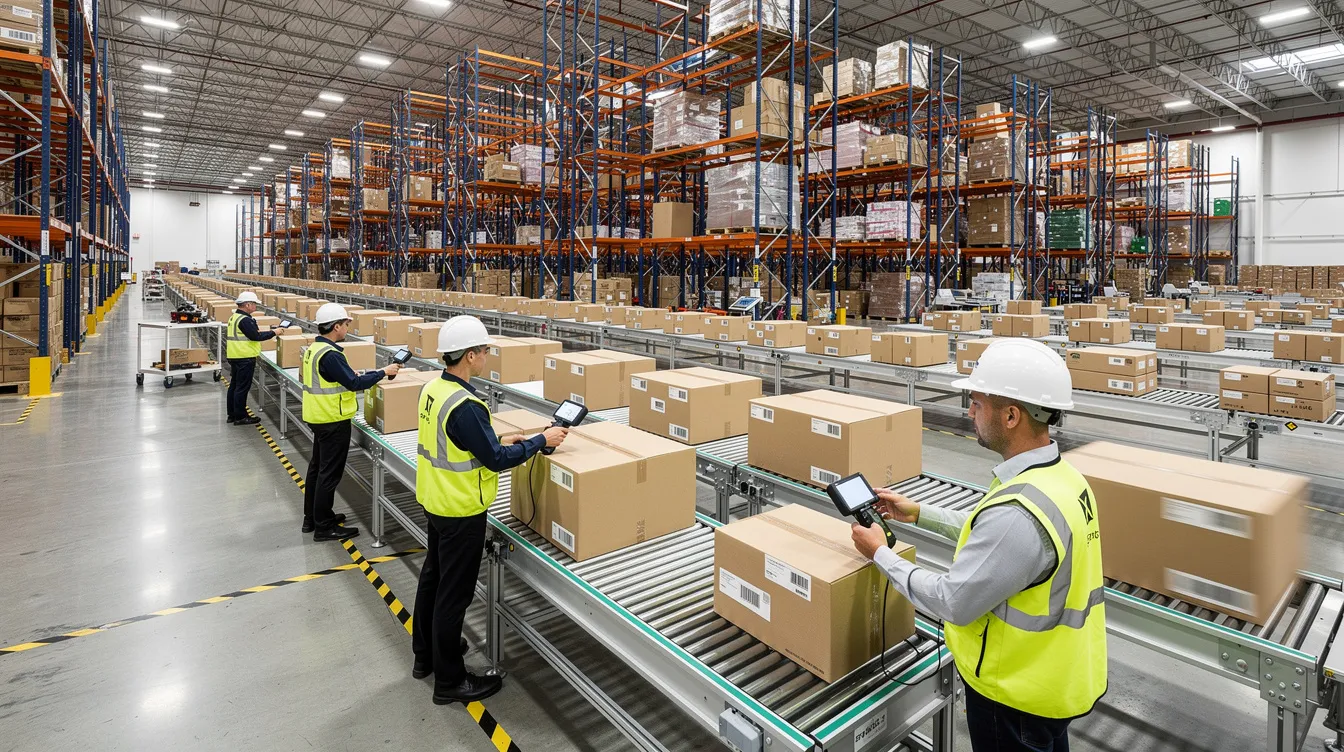
The warehouse management system WMS is where the one-day fulfillment guarantee either succeeds or fails. It directs every physical action on the warehouse floor: where pickers go, what they scan, how items are verified, and when packages are sealed.
Key capabilities that enable speed without sacrificing accuracy:
- WMS-directed picking with scan verification at each step - barcode scanning confirms the right SKU is pulled from the right location
- Automated pick path optimization that routes warehouse staff through the most efficient sequence, reducing walk time by 20–40%
- Real-time inventory allocation and reservation that prevents overselling the moment a customer places an order
- Weight verification and label validation before carrier handoff, catching errors at the packing station before they become returns
- Exception handling for damaged items and short-picks, flagging issues to supervisors immediately
AI-driven inventory management predicts demand and optimizes item placement, ensuring high-velocity SKUs sit in prime pick locations. Predictive analytics analyzes historical data to pre-position inventory in local hubs, reducing the distance between product and customer.
Warehouse automation increases picking throughput and reduces operational friction. Automated Guided Vehicles and Autonomous Mobile Robots reduce order processing times in high-volume facilities. Scan-based workflows achieve 99.7% inventory accuracy rates - a critical factor for brands that can't afford stockouts during peak demand.
Carrier Selection and Label Generation (KNCT)
Once an order is packed and verified, the system must select the right carrier, generate the shipping label, and schedule pickup - all without human decision-making slowing the process.
ShipNetwork's KNCT technology automates carrier selection based on weight, dimensions, origin, destination, shipping speed requirements, and cost. Advanced shipping optimization solutions help select the best carrier and rate for packages by evaluating multiple national and regional shipping carriers simultaneously.
The system handles:
- Real-time label generation through carrier API integration
- Carrier pickup scheduling and deadline management to ensure same day handoff
- Multiple carrier relationships for redundancy - if one carrier has capacity issues, orders route to alternatives
- Carrier performance tracking and scorecarding to continuously improve delivery outcomes
Dynamic routing algorithms optimize courier routes based on real-time conditions. Companies using real-time tracking report a 31% decrease in route costs. Dynamic last-mile delivery optimization improves efficiency across the final and most expensive leg of the supply chain.
This is where shipping costs get controlled without sacrificing speed. The right technology turns carrier selection from a manual, error-prone task into an automated decision that runs in milliseconds.
Real-Time Tracking Infrastructure
Real-time tracking is more than a tracking link that updates once a day. It's a system that reflects actual operational status at every stage of the fulfillment process.
Order-level tracking should show:
Placed → Processing → Picked → Packed → Labeled → Carrier Scanned → In Transit → Out for Delivery → Delivered
Inventory-level tracking provides real time inventory visibility into units received, available, reserved for orders, in pick, and restocked from returns. Real-time tracking updates inventory instantly during item movement, preventing the overselling and stockout errors that plague brands relying on periodic inventory syncs. Inventory management software helps track stock levels in real-time, giving brands accurate data for purchasing decisions across all sales channels.
Exception tracking surfaces problems proactively: delayed shipments, failed deliveries, and carrier issues appear as alerts - not as angry customer emails three days later. Transparent delivery status reduces customer service inquiries regarding order location.
Post-purchase tracking via carrier API integration feeds live scan data from carriers directly into the brand's dashboard and customer-facing tracking pages. IoT sensors and GPS provide continuous location telemetry and estimated arrival updates, giving customers the exact location of their package.
The business impact is significant:
- Real-time tracking reduces "Where Is My Order?" inquiries by 60–75%, freeing support teams to handle complex issues
- Live tracking maps reduce customer anxiety about order status
- Real-time tracking improves on-time deliveries from 84% to 99.2%
- Real-time tracking can improve order accuracy to 99.7% by catching discrepancies early
- Real-time tracking builds customer trust and satisfaction by providing accurate updates at every stage
The delivery experience becomes a competitive advantage rather than a source of support tickets. Automated updates can reduce customer inquiries by 60–75%, creating cost savings that compound across high shipping volume operations.

Quality Control and Accuracy Systems
Speed without accuracy is a churn accelerator. Fast delivery of the wrong item is worse than slow delivery of the right one.
The dual commitment to speed and accuracy defines superior service quality. ShipNetwork's 100% order accuracy promise - backed by a Flawless or Free guarantee - is built on technology-enforced quality control at every stage:
- Scan verification at pick: Barcode scanning confirms correct SKU and quantity
- Scan verification at pack: Items re-verified against the order before the box is sealed
- Weight and dimension verification: Automated checks catch missing items or incorrect products
- Label verification before carrier handoff: Ensures the right package goes to the right address
- Visual inspections: Final human check before the package leaves the packing station
Automation can increase order accuracy rates to 99.7%. ShipNetwork pushes further - maintaining 99.99% accuracy through layered verification that combines technology with trained human oversight.
Accurate inventory management reduces stockouts and backorders. Real-time tracking updates inventory instantly to prevent errors. The focus is error prevention rather than error correction - catching problems before they ship is exponentially cheaper than managing returns and reshipments through reverse logistics.
Peak Volume Management Technology
What happens to click-to-ship time and accuracy during Black Friday, product launches, or subscription cohort ship dates separates technology-driven fulfillment operations from manual ones that degrade under pressure.
3PLs can help manage spikes in demand during peak periods through:
- Scalable infrastructure that maintains performance whether processing 500 or 50,000 orders per day
- Automated workforce management and capacity planning based on forecasted volume
- Real-time bottleneck identification - dashboards showing which zones, stations, or carriers are falling behind
- Subscription cohort ship date management so recurring shipments don't compete with flash sale volume
Automated fulfillment centers streamline order processing to enhance service efficiency even at 3–5x normal volume. Same-day fulfillment can reduce delivery times by 25% when warehouse capacity and carrier scheduling align.
Micro-Fulfillment Centers position inventory closer to customers to reduce shipping times, distributing peak load across multiple facilities rather than overwhelming a single location. This distributed approach to inventory control means no single fulfillment center becomes a bottleneck.
The difference between a technology-driven operation and a manual one becomes obvious during peaks: manual processes rely on overtime and temporary labor that hasn't been trained, while automated systems scale by processing more volume through the same verified workflows.
Technology Component Comparison
How to Build Superior Fulfillment Technology Infrastructure
Choose Based on Integration Capabilities
The right fulfillment partner offers API connectivity between your ecommerce platforms, their warehouse management system, and carrier networks. Real-time data synchronization is non-negotiable - any delay between an order appearing on your Shopify store and reaching the pick queue is time lost from your click-to-ship window.
Platform-specific integration needs vary. Brands selling across Amazon, Walmart, and their own direct to consumer storefront need an order management system that normalizes orders from all sales channels into a single fulfillment queue. This eliminates manual data entry, reduces errors, and ensures consistent fulfillment speed regardless of where the customer orders.
Fulfillment technology connects ecommerce platforms and warehouse systems. If those connections require CSV uploads or manual intervention, you're building latency into every order.
Choose Based on Scalability Requirements
Evaluate your current order volume, projected growth, and peak season capacity needs. A fulfillment partner that handles your current 5,000 monthly orders but can't scale to 25,000 during Q4 will force a painful mid-season migration.
Geographic expansion matters too. As ecommerce brands grow, the optimal fulfillment center strategy shifts from single-warehouse to distributed network. This reduces average transit distance, lowers shipping costs, and improves the customer experience for buyers in every region.
Consider the numbers: 39% of customers abandon purchases due to high shipping costs, and 21% abandon carts if delivery is too slow. Outsourcing fulfillment can improve operational efficiency significantly while using a third party logistics provider can reduce operating costs for ecommerce businesses. Outsourcing fulfillment allows brands to focus on core competencies - product development, marketing, customer relationships - rather than managing warehouse staff and carrier negotiations.
Choose Based on Accuracy Standards
Target order accuracy rates of 99%+ for competitive advantage. Below that threshold, the cost of returns, reshipments, and lost customers erodes any margin gained from cheaper fulfillment.
Effective inventory management minimizes costs associated with excess stock while preventing the stockouts that kill customer satisfaction. Quality control process automation - scan verification, weight checks, supervisor override logging - must be built into the technology, not bolted on as an afterthought.
The accuracy standard you accept from your fulfillment partner directly shapes your customer experience. Happy customers come from correct orders delivered quickly, not from apology emails and return labels.
Technology Glossary
- Click-to-ship time: Duration from when a customer places an order to when the package is scanned by the carrier. The primary measure of fulfillment speed.
- One-day fulfillment: Orders received by cutoff time are processed and shipped within one business day. Distinct from next day shipping, which refers to carrier transit time.
- On-time delivery rate: Percentage of orders delivered by the promised date. Influenced by both fulfillment speed and carrier performance.
- Order accuracy rate: Percentage of orders shipped with correct items, quantities, and packaging. Industry leaders target 99.9%+.
- WMS: Warehouse management system. Software that directs warehouse operations including receiving, storage, picking, packing, and shipping.
- KNCT: ShipNetwork's proprietary shipping optimization solution that analyzes package characteristics and destination to select the best carrier and rate.
- Post-purchase tracking: Customer-facing order status updates delivered after purchase, from fulfillment through delivery.
- Carrier API: Real-time data connection between fulfillment systems and shipping carriers, enabling automated label generation, tracking updates, and performance monitoring. A transportation management system often incorporates carrier APIs as part of broader logistics orchestration.
Which Technology Approach Is Best for Your Business
- Choose integrated 3PL technology if you need immediate one-day fulfillment without building warehouse infrastructure. This works for ecommerce brands shipping 5,000+ orders monthly that want proven fulfillment services without capital investment. Same-day fulfillment involves shipping orders on the same day the order arrives, while same-day delivery requires complex last-mile logistics - a 3PL handles the fulfillment side so you don't have to solve both.
- Choose hybrid technology solutions if you want to maintain some internal inventory control while outsourcing complex fulfillment operations. This suits brands with unique kitting, deep expertise in their product handling, or regulatory requirements.
- Choose full technology partnership if your priority is 100% order accuracy with 12-hour click-to-ship time across all sales channels. This is where a fulfillment expert like ShipNetwork operates - providing the complete technology stack, warehouse network, and operational execution as a unified service. Online shopping demands keep rising, and the brands meeting customer expectations are the ones whose supply chain management runs on integrated, automated systems.

Partner with ShipNetwork for Superior Fulfillment Technology
ShipNetwork delivers the key pillars of competitive ecommerce fulfillment:
- One-day fulfillment guarantee with 12-hour average click-to-ship time
- 100% order accuracy promise backed by Flawless or Free
- Real-time tracking and advanced inventory management technology across every stage
- Proven reliability and consistency across volume spikes, peak seasons, and cross border logistics
- Advanced KNCT technology for shipping optimization across all major carriers
This is just the beginning. Whether you're scaling a direct to consumer brand or managing global fulfillment across multiple channels, the right technology and the right fulfillment partner make the difference between a cost effective operation and one that bleeds margin on every order.
Request a quote to see how ShipNetwork's fulfillment technology performs for your business.
FAQs
A one-day fulfillment guarantee means that customer orders received by the defined cutoff time are picked, packed, labeled, and carrier-scanned within one business day. The commitment covers everything from order receipt through carrier handoff. It does not cover carrier transit time - that's a separate variable determined by distance, carrier service level, and shipping method. ShipNetwork's one-day fulfillment guarantee ensures every order moves through the complete fulfillment process and into the carrier network within a single business day.
ShipNetwork's 12-hour average click-to-ship relies on an integrated technology stack: a custom-built warehouse management system for directed picking and packing, real-time OMS integration that routes orders to the pick queue instantly, and KNCT for automated carrier selection and label generation. Real time visibility into inventory levels prevents delays from stockouts. Exception handling flags problems immediately rather than letting them queue. The result is a fulfillment process that moves from order receipt to carrier scan in half the time of the one-day SLA.
In a properly built 3PL fulfillment operation, real-time tracking means a live dashboard showing each order's progression: placed, processing, picked, packed, labeled, carrier scanned, in transit, and delivered. It includes instant carrier API updates and proactive exception alerts when shipments are delayed or addresses can't be verified. Self service portals give brands access to order and inventory data without waiting for email responses. This level of real time visibility is what separates modern ecommerce fulfillment from legacy operations.
A 12-hour click-to-ship time plus 1–2 day carrier transit produces 2–3 day total delivery for most U.S. addresses. When customers consistently receive orders in 2–3 days via ground shipping, post-purchase reviews reflect it - mentions of "fast delivery" and "quick exchanges" signal that the underlying fulfillment operation is executing reliably. Andie Swim achieved 99% on-time delivery through consistent click-to-ship execution with ShipNetwork, driving higher customer satisfaction and repeat purchases. The relationship between fulfillment speed and positive reviews is direct and measurable.
Yes - if the operation is technology-driven. Automated capacity management, real-time bottleneck identification, and distributed fulfillment networks allow a 3PL to maintain consistent performance during volume spikes. Manual operations that depend on temporary labor and paper-based processes degrade under pressure. Technology-driven operations scale by processing higher volume through the same verified, automated workflows. Customer demand during Black Friday or product launches shouldn't change the SLA - the system should absorb the volume without compromising the ecommerce order fulfillment process.
Speed without accuracy accelerates customer churn. Every incorrect order generates a return, a reshipment, a support ticket, and often a lost customer. The cost of a single error - when you factor in return shipping, labor, replacement product, and customer lifetime value loss - typically exceeds the cost of fulfilling the original order correctly. A 100% order accuracy guarantee combined with one-day fulfillment defines superior service quality. It means the brand can promise fast delivery and know that what arrives is exactly what the customer ordered. Many ecommerce brands underestimate accuracy's impact on operational efficiency until error costs start compounding.
.svg)